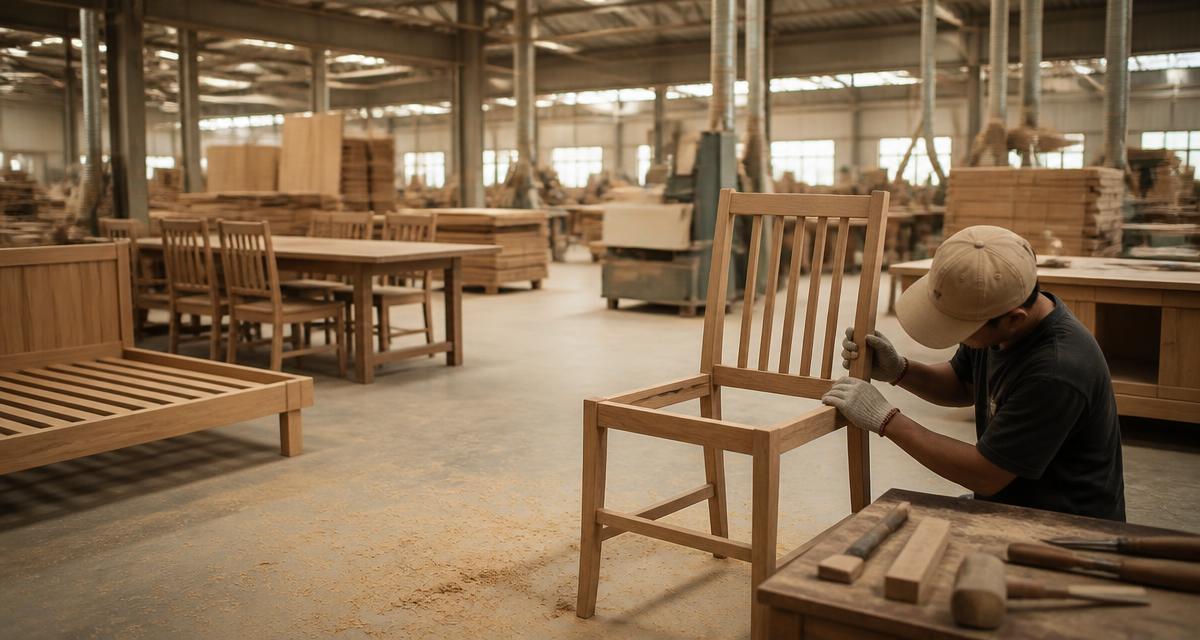
ASEAN is one of the world''s largest solid-wood furniture manufacturing regions, shipping dining sets, bedroom suites, office desks and hospitality casegoods to the US, EU, Australia and the Middle East. Vietnam leads on volume and flat-pack OEM; Indonesia and Thailand specialize in teak and rubberwood craftsmanship; Malaysia supplies tropical hardwood components and knock-down kits. For importers, the region offers price-competitive woodwork with shorter lead times than China on many categories — but success depends on locking species, moisture, finish and compliance specs before production starts.
What each country does best
- Vietnam: acacia, rubberwood and oak-veneer dining and bedroom furniture at high volume. Strong at flat-pack (KD) construction, CNC-machined parts, consistent finishing and container consolidation.
- Indonesia: teak, mahogany and sungkai indoor/outdoor furniture, hand-finished dining sets, carved headboards and hospitality casegoods. Best for premium, design-led lines.
- Thailand: rubberwood (Hevea) bedroom and kids'' furniture, finger-jointed panels, office desks and chairs. Sustainable raw material by definition and strong export infrastructure through Laem Chabang.
- Malaysia: rubberwood and tropical hardwood knock-down frames, components and mid-market dining furniture. Good for mixed-container orders and component sourcing.
Specifications that protect you
Furniture claims fail when specs are verbal. Fix these in the PO:
- Wood species: state the exact species (e.g., Hevea brasiliensis, Acacia mangium, Tectona grandis) and acceptable substitutes. Do not accept "mixed hardwood" without definition.
- Moisture content: 8–12% at loading for temperate markets; 10–14% for tropical destinations. Require meter readings per lot.
- Joinery and construction: specify mortise-and-tenon, dowel, screw-and-block or metal bracket methods; define glue type and clamping standards.
- Finish system: NC, AC, PU, UV or water-based; define sheen, color code, number of coats and scratch/adhesion tests.
- Hardware: drawer slides, hinges, screws and casters must be brand- or grade-named; cheap hardware is the most common warranty claim.
- Dimensions and tolerance: overall dimensions ±3mm, squareness, flatness of tabletops and door alignment.
Compliance and sustainability paperwork
The EU Deforestation Regulation (EUDR) now requires geolocation traceability of the timber plot for any solid wood entering the EU — informal supply chains are no longer viable. FSC or PEFC chain-of-custody certification is the practical route to compliance and is increasingly required by EU and major US retailers. US buyers must also ensure accurate Lacey Act declarations. We verify mill scope certificates, species declarations and harvest geolocation before a supplier enters our network.
For finished furniture, additional rules apply: California Prop 65 and CPSIA for products with children''s access; REACH/SVHC and formaldehyde limits (E1/E0, CARB Phase 2 / EPA TSCA Title VI) for composite parts such as MDF backs, drawer bottoms or veneered panels.
MOQs and pricing structure
Solid-wood furniture is container-driven. A typical first order is one 40ft HC, often mixed across 3–5 SKUs. Per-unit FOB references for Vietnam/Thailand mid-market production:
- Dining chair: US$28–65 depending on species and finish
- Dining table (1.4–1.8m): US20–320
- Bed frame (queen): US80–420
- Office desk: US$90–220
Prices move with log, resin, hardware and ocean-freight costs. Mixed containers help new buyers test a range without committing to full SKU minimums.
QC checkpoints
- Incoming timber: verify species, moisture and FSC/legality documentation
- First-article inspection: dimensions, joinery, finish color and hardware match approved samples
- During production: glue-bond and assembly checks, moisture re-tests after kiln adjustment
- Pre-shipment: finish adhesion/scratch test, functional testing of drawers/doors, packaging drop test for flat-pack
- Container loading: corner protection, moisture barrier, desiccant, load photos and condition report
Logistics and packaging notes
Knock-down (KD) furniture packs far more efficiently than fully assembled — often 2–3x more pieces per container. Specify whether you want KD, semi-KD or fully assembled; each affects labor, freight cube and final landed cost. Solid wood is heavy: a 40ft HC of dining furniture can hit weight limits before cube. Vietnam to US West Coast transits 20–26 days; Indonesia to Rotterdam 24–30 days; Thailand to Australia 12–18 days.
How TUSKO helps
We audit mills for species traceability and certification validity, confirm moisture and joinery specs at first production, and supervise pre-shipment and loading. One contact, one landed price, fees built into the product cost.
Talk to us: WhatsApp Business @tuskoconsulting (reply within 12-24 hours) or contact@tuskoconsulting.com.
FAQ
Can I mix dining, bedroom and office SKUs in one container?
Yes, most factories accept mixed 40ft HC orders across 3–5 SKUs as long as each SKU meets its minimum (typically 100–200 pcs for chairs, 50–100 pcs for tables/beds). This is the best way for new buyers to test the line.
How do I prove EUDR compliance for solid wood furniture?
You need geolocation coordinates of the harvest plot, due-diligence documentation and a deforestation-free declaration. The practical path is to source from FSC/PEFC chain-of-custody certified mills and have the certificate verified by a third party.
What is the most common quality issue with ASEAN wood furniture?
Inconsistent moisture content and finish color matching between batches. Lock the target moisture range and approved color sample (with tolerance) in the purchase order, and re-check at pre-shipment inspection.