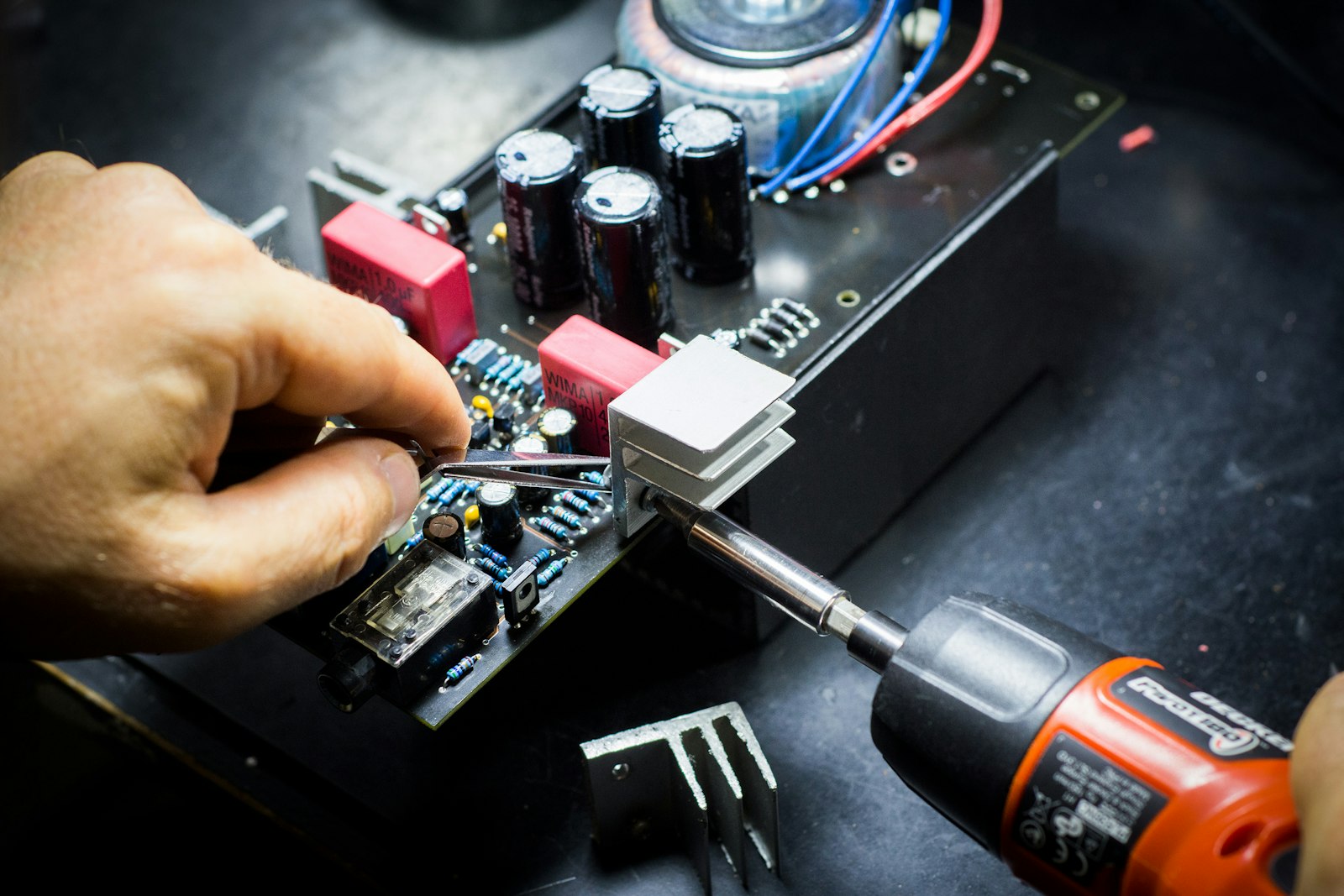
Illustrative image only; unrelated to real brands or clients. It does not depict a TUSKO client, product or factory. TUSKO maintains client and commercial confidentiality under NDA.
Unsplash illustration of electronic assembly work; the image does not identify a proximity sensor or an ASEAN production site.
Inductive, capacitive and magnetic proximity sensors detect position without contact on conveyors, packaging machines, presses and mobile equipment. For an OEM or automation distributor, a replacement that matches thread size and housing colour can still differ in rated sensing distance, output logic, switching frequency or EMC immunity, which leads to false triggers or missed detections on the line. This ASEAN manufacturing and export guide is written for importers, OEMs and distributors in the United States, European Union, United Kingdom, Australia, Canada and Japan who need a dependable route from specification to delivered, compliant goods.
Quick Answer: What Should an Overseas Buyer Specify?
Start with the complete application and a controlled specification, then qualify the actual manufacturing route. For industrial proximity sensors, the critical details are sensor type and sensing distance, housing size and mounting style, output type and logic, supply voltage, connection and IP rating. Require documented first-article and shipment acceptance, verify destination-market obligations for the exact product, and review landed cost with current origin and customs evidence. A country name, certificate logo or matching photograph is not enough to approve a substitution.
Where in ASEAN Should You Evaluate Manufacturing?
ASEAN is a region, not a guarantee of a particular production capability. Compare manufacturing sites in Thailand, Vietnam, Malaysia and Indonesia using the same evidence pack. Country choice should follow verified process capability, component availability, export execution and the buyer’s required volume. This table is a screening framework, not a claim that every country has qualified suppliers for this product.
| Location to evaluate | Evidence to request | Decision rule |
|---|---|---|
| Thailand | Actual operations, test equipment, controlled drawings and shipment route | Advance only a site whose documented process fits the approved design |
| Vietnam | Production versus trading role, component traceability and change control | Verify local manufacturing steps and qualification evidence |
| Malaysia | Application knowledge, material records and relevant test capability | Check model-specific scope rather than relying on a certificate logo |
| Indonesia | Assembly/manufacturing controls, packing and export documentation | Confirm repeat-lot consistency and a viable shipment plan |
For industrial proximity sensors, imported subcomponents may be part of an ASEAN build. Identify material and component sources, transformation steps and the applicable origin rule before making a country-of-origin claim. Shipment from an ASEAN port does not by itself establish ASEAN origin, and an attractive unit quotation should not outweigh missing qualification evidence. Compare the same approved specification across candidates and document unresolved questions before choosing a production route.
How Industrial Proximity Sensors Are Manufactured and Qualified
Proximity sensors combine a coil or electrode, an oscillator and switching circuit on a PCB, potting compound, a threaded metal or plastic housing, and a cable or M8/M12 connector. Production quality depends on PCB assembly, coil winding consistency, calibration of the switching point, potting that is free of voids, and sealing of the cable entry. Many sites assemble from imported electronic components, so traceability of key components and a controlled calibration process are central qualification points.
Ask TUSKO to establish which operations are performed at the manufacturing site and which components are externally procured, then build the inspection plan around the actual process. Before changing production location, compare approved drawings and functional data with the original application rather than copying a catalogue photograph.
Key Specifications to Lock Before Requesting Quotes
Use the following as a product-specific RFQ checklist. State the drawing revision and applicable standard edition, distinguish mandatory requirements from optional preferences, and require written clarification where the proposed build differs. A quoted alternative should identify the deviation so it can be reviewed before approval.
| Specification | What to define | Why it matters |
|---|---|---|
| Sensor principle | Inductive, capacitive or magnetic; target material | Inductive sensors detect metals only; correction factors apply to non-ferrous metals |
| Sensing distance | Rated distance Sn and assured operating distance | Mounting margins depend on assured, not nominal, range |
| Mounting | Flush or non-flush; M8, M12, M18, M30 or rectangular | Flush sensors have shorter range but can be embedded |
| Output | PNP/NPN, NO/NC, 2-wire, analogue or IO-Link | Wrong logic will not work with the controller input card |
| Electrical | Supply voltage range, load current, short-circuit protection | Protects controller and sensor from wiring faults |
| Environment | IP67/IP68/IP69K, temperature, weld-field or washdown resistance | Determines service life in harsh areas |
Application Selection: The Engineering Details That Change the Order
Inductive sensing distance is quoted against a standard mild-steel target under IEC 60947-5-2. Aluminium, brass and stainless steel targets reduce the effective range, so the application should state the target material and size. Design the mounting position to the assured operating distance with margin for temperature drift and tolerances.
Switching frequency limits how fast a target can pass. High-speed counting of gear teeth or cams needs a sensor rated well above the actual pulse rate. For welding cells, ask for weld-field-immune designs; for food plants, stainless housings and IP69K washdown ratings may be required.
Connector choice affects maintenance. M12 quick-disconnect sensors simplify replacement, while integral cables may seal better in some environments. Specify pin assignment and cable material (PVC or PUR) explicitly.
Quality Checks and First-Article Acceptance
Agree on the evidence before production starts. Tests need a method, conditions and acceptance limits, not simply a request for a test certificate. Distinguish first-article checks, which prove the design and process can deliver the specification, from routine lot checks, which confirm each shipment stays within it. Record sample sizes and the response if a lot fails.
| Check | Method or evidence | Acceptance focus |
|---|---|---|
| Sensing distance | Measured switching point on standard target across a sample | Within tolerance of rated distance |
| Output function | Electrical test of logic, load current and LED indication | Correct PNP/NPN, NO/NC behaviour |
| Protection features | Reverse polarity and short-circuit tests on samples | Sensor survives and recovers as specified |
| Sealing | IP verification by test report; potting inspection | No ingress; no voids at cable entry |
| EMC | Test report to IEC 60947-5-2 EMC requirements | Immunity and emission within limits |
| Marking | Part number, wiring diagram, batch code | Traceable and correctly labelled |
Destination-Market Compliance for Industrial Proximity Sensors
In the EU, proximity sensors are typically assessed under the EMC Directive 2014/30/EU and RoHS Directive 2011/65/EU; low-voltage AC versions may also fall under the Low Voltage Directive. IEC/EN 60947-5-2 is the common product standard. UKCA requirements mirror these in Great Britain.
In North America, buyers often require UL or cUL recognition for sensors used in industrial control panels, and FCC rules may be relevant for some electronic products. Confirm which listings your customers or panel builders demand.
Sensors used as part of safety functions are a different category: safety-rated sensors need certification to functional-safety standards. Standard proximity sensors must not be presented as safety devices.
Regulations change and depend on the exact configuration, so confirm current requirements with a qualified customs broker or compliance specialist before the first shipment. TUSKO coordinates the evidence pack but does not replace legal or conformity-assessment advice.
Landed Cost: What to Include Before Comparing Quotes
Compare delivered cost, not unit price. The following structure keeps quotations comparable. Figures depend on volume, specification and route, so no universal price or saving is implied.
| Cost element | What to confirm | Why it matters |
|---|---|---|
| Ex-works or FOB unit price | Quoted against the same approved specification and revision | Different specs make price comparison meaningless |
| Tooling, samples and first-article work | One-off or amortised; who owns tooling | Affects true cost of the first orders |
| Packing and palletising | Export packing, labelling, moisture and impact protection | Damage claims erase unit-price savings |
| Freight and insurance | Mode, consolidation and Incoterm responsibility | Volume and density drive cost per unit |
| Duties and border costs | Tariff classification, origin evidence, trade-remedy checks | Classification and origin must be verified for the exact product |
| Testing and compliance | Third-party tests, certificates and marking work | Required before sale in many destination markets |
Sampling and Production Process
A disciplined sequence reduces surprises: (1) send the specification pack and application data; (2) receive clarifications and deviations in writing; (3) approve pre-production samples against measured data; (4) run a pilot lot with first-article inspection; (5) release mass production with in-process and pre-shipment checks; (6) review the first delivered lot and lock the change-control process. Any change of material, sub-supplier or process after approval should require written notice and re-qualification proportional to the risk.
Five Common Mistakes When Sourcing Industrial Proximity Sensors
- Choosing by thread size alone. Risk: Wrong output logic or range on installation. Fix: Specify type, Sn, output and connector on the PO.
- Ignoring target material. Risk: Missed detection on aluminium or stainless parts. Fix: Test with the actual target during sampling.
- Accepting a CE logo without a test report. Risk: No evidence of EMC conformity. Fix: Request the declaration and supporting reports.
- Overlooking switching frequency. Risk: Lost counts at line speed. Fix: Check rated frequency against the real pulse rate.
- Using standard sensors as safety devices. Risk: Unsafe machine and liability exposure. Fix: Use certified safety-rated devices for safety functions.
Frequently Asked Questions
Are proximity sensors made in ASEAN?
Electronic assembly capability is strong in parts of the region, but each site's calibration, testing and component traceability must be verified for this product.
What is the difference between PNP and NPN?
PNP sensors switch the positive supply to the load; NPN switch to 0 V. They must match the controller input type.
Why is my inductive sensor's range shorter on aluminium?
Non-ferrous metals have correction factors that reduce sensing distance compared with the mild-steel reference target.
Do I need CE marking for sensors sold in Europe?
Usually yes, under EMC and RoHS directives at minimum; confirm applicable directives for each model.
What does IP69K mean?
It indicates resistance to high-pressure, high-temperature washdown, commonly requested in food and beverage plants.
What should I send TUSKO for a sensor enquiry?
Existing part number, sensor type, size, flush or non-flush, Sn, output, voltage, connector, environment, certifications, destination and expected volumes.
How TUSKO Supports Your ASEAN Sourcing Enquiry
TUSKO supports ASEAN sourcing and trade enquiries as your single point of contact. Send the specification pack, destination, required documentation and expected order pattern so the enquiry can be evaluated against real capability and shipment requirements. The order quotation is assessed against the agreed scope and landed-cost assumptions, rather than an unsupported promise of the lowest price.
Email hello@tuskoconsulting.com or reach WhatsApp Business @tuskoconsulting through the contact page. We reply within 12–24 hours. For preliminary budgeting, use the landed-cost calculator; explore the ASEAN product recommender for related categories.
Sources and Scope
The technical guidance draws on publicly available manufacturer documentation and official standards or regulatory guidance. These sources explain product selection and scope; they do not verify a particular ASEAN manufacturing site, imply a TUSKO client result or establish universal prices, capacity or lead times.
- IEC 60947-5-2 – Proximity switches
- European Commission – EMC Directive
- European Commission – RoHS
- UL Solutions