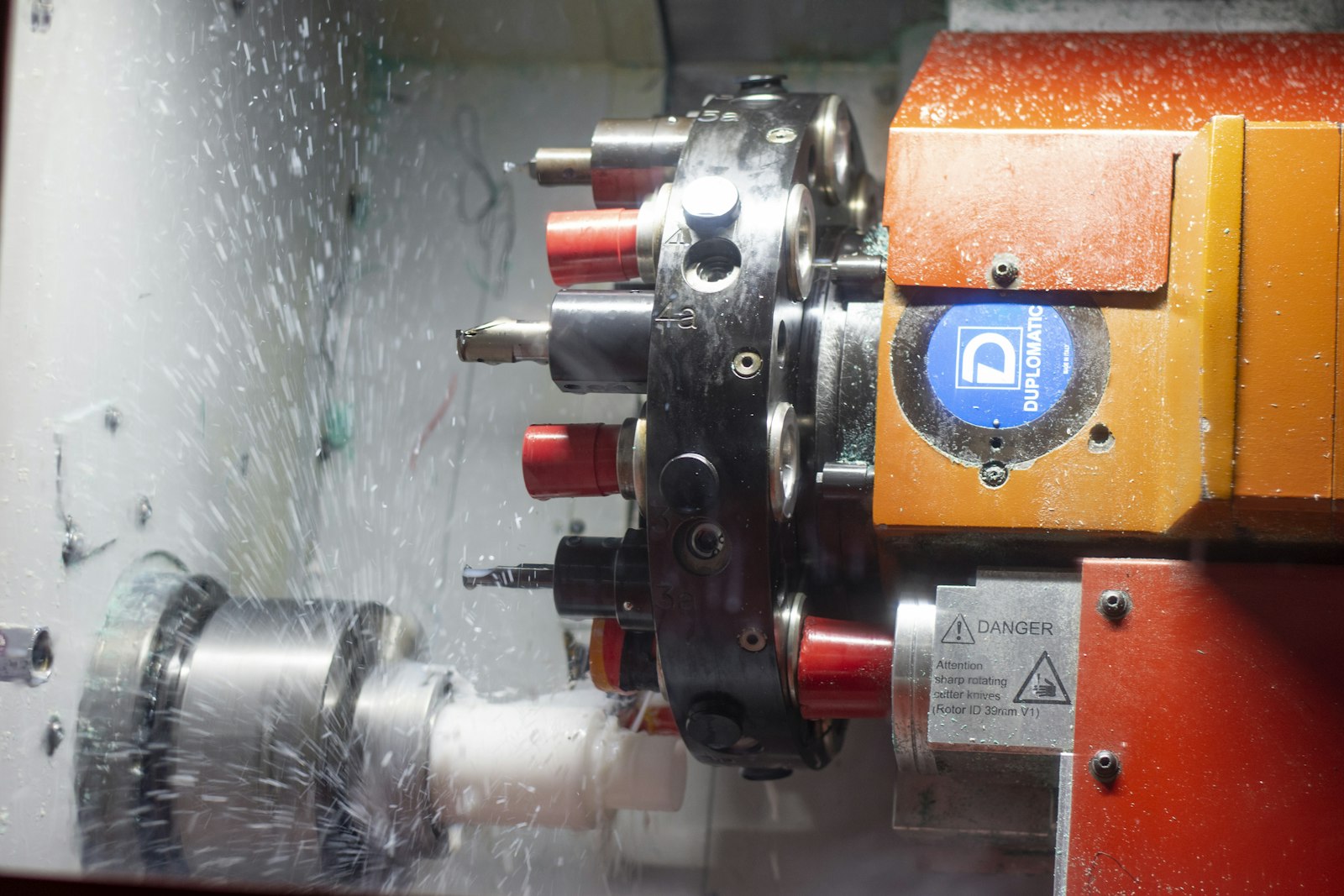
Illustrative image only; unrelated to real brands or clients. It does not depict a TUSKO client, product or factory. TUSKO maintains client and commercial confidentiality under NDA.
Unsplash illustration of metalworking equipment; the image does not identify a pneumatic cylinder or an ASEAN production site.
Pneumatic cylinders turn compressed air into linear motion in packaging, assembly, material handling and other automation applications. For an overseas OEM or maintenance distributor, the buying challenge is not finding a cylinder that looks similar: it is matching force, installation dimensions, service conditions and repeatability. A nominally equivalent replacement can still have different port threads, rod-end geometry, cushioning performance or sensor compatibility. This ASEAN manufacturing and export guide focuses on cylinder-specific decisions rather than repeating the broader air-compressor and pneumatic-tools discussion.
Quick Answer: What Should an Overseas Buyer Specify?
Start with the complete application and a controlled specification, then qualify the actual manufacturing route. For pneumatic cylinders, the critical details are bore, rod and stroke, mounting interface, operating conditions, ports and flow. Require documented first-article and shipment acceptance, verify destination-market obligations for the exact product, and review landed cost with current origin and customs evidence. A country name, certificate logo or matching photograph is not enough to approve a substitution.
Where in ASEAN Should You Evaluate Manufacturing?
ASEAN is a region, not a guarantee of a particular production capability. Compare manufacturing sites in Thailand, Vietnam, Malaysia and Indonesia using the same evidence pack. Country choice should follow verified process capability, component availability, export execution and the buyer’s required volume. This table is a screening framework, not a claim that every country has qualified suppliers for this product.
| Location to evaluate | Evidence to request | Decision rule |
|---|---|---|
| Thailand | Actual operations, test equipment, controlled drawings and shipment route | Advance only a site whose documented process fits the approved design |
| Vietnam | Production versus trading role, component traceability and change control | Verify local manufacturing steps and qualification evidence |
| Malaysia | Application knowledge, material records and relevant test capability | Check model-specific scope rather than relying on a certificate logo |
| Indonesia | Assembly/manufacturing controls, packing and export documentation | Confirm repeat-lot consistency and a viable shipment plan |
For this product, imported subcomponents may be part of an ASEAN build. Identify material and component sources, transformation steps and the applicable origin rule before making a country-of-origin claim. Shipment from an ASEAN port does not by itself establish ASEAN origin. Equally, an attractive unit quotation should not outweigh missing qualification evidence. Compare the same approved specification across candidates and document unresolved questions before choosing a production route.
How Pneumatic Cylinders Are Manufactured and Qualified
A cylinder program may include machined end caps, a finished barrel, a piston, a ground piston rod, seals, bearings and mounting accessories. Manufacturing controls need to connect barrel geometry and rod surface condition with assembly cleanliness and seal handling. Leakage cannot be inferred from a dimensional report alone. Ask TUSKO to establish which operations are performed at the manufacturing site and which components are externally procured, then build the inspection plan around the actual process. A metalworking capability does not, by itself, demonstrate reliable cylinder assembly or endurance testing. Before changing production location, compare approved drawings and functional data with the original application rather than copying a catalog photograph.
Key Specifications to Lock Before Requesting Quotes
Use the following as a product-specific RFQ checklist. State the drawing revision and applicable standard edition, distinguish mandatory requirements from optional preferences, and require written clarification where the proposed build differs. A quoted alternative should identify the deviation so it can be reviewed before approval.
| Specification | What to define | Why it matters |
|---|---|---|
| Bore, rod and stroke | Record all three dimensions and usable travel | Determines force, air consumption and installation envelope |
| Mounting interface | Controlled drawing; ISO 15552 or ISO 6432 where applicable | Check accessory geometry and rod-end dimensions, not just the standard label |
| Operating conditions | Pressure at actuator; load, speed, duty and orientation | Establish required force and end-of-stroke energy |
| Ports and flow | Thread designation, size and valve/tubing arrangement | G, NPT and other thread systems are not automatically interchangeable |
| Seals and lubrication | Temperature, medium, air quality and lubrication assumptions | A different seal compound may alter friction, leakage and service life |
| Cushioning and sensing | Adjustable cushion or bumper; magnet and sensor details | Must match the stopping requirement and electrical interface |
Application Selection: The Engineering Details That Change the Order
For preliminary sizing, theoretical extension force is pressure multiplied by piston area; retraction force uses the annular area after subtracting rod area. For example, a 50 mm bore at 6 bar gives approximately 1,178 N theoretical extension force before friction and other losses. This is a calculation example, not an operating recommendation. Actual available force must account for pressure at the cylinder during motion, friction, exhaust restrictions and the required design margin. Speed and stroke affect air demand and end-of-stroke energy. A cylinder suitable for a light horizontal push may be unsuitable for an unsupported vertical load. Side loads need appropriate guides, and vertical movements require a machine-level assessment of what happens when air pressure disappears. ISO mounting dimensions help compare installation envelopes but do not make all cylinders functionally interchangeable.
Quality Checks and First-Article Acceptance
Agree on the evidence before production starts. Tests need a method, conditions and acceptance limits, not simply a request for a test certificate. Distinguish one-time design qualification from routine lot or shipment checks. For critical attributes, the responsible engineer should decide whether sampling is sufficient or a different verification approach is required.
| Checkpoint | Method or evidence | Acceptance basis |
|---|---|---|
| Dimensions and accessories | Measure mounting centres, rod end, ports, stroke and accessory fit | Approved drawing and first-article record |
| Leakage and movement | Document test pressure, stabilization, measurement method and direction | Agreed leakage limits and smooth travel criteria |
| Cushioning | Exercise representative load and speed under guarded conditions | Agreed end-of-stroke behaviour, no unexplained impact |
| Sensors | Verify switch points and interface with specified sensor | Recorded repeatability and correct output type |
| Endurance and repeat lots | Run qualification cycles representative of actual use | Defined cycle conditions; traceable build and seal revision |
Mistake 1: Sizing on catalog force alone
⚠️ Risk: Catalog values may be theoretical, while line pressure falls during motion. In a fast machine, restrictions and exhaust backpressure can make a cylinder miss its cycle even when the nominal bore appears adequate.
✅ The Fix: Confirm dynamic pressure and load at the installation. Evaluate both extension and retraction, include friction and margin, and have the machine engineer approve the selection.
Mistake 2: Treating ISO mounting as complete interchangeability
⚠️ Risk: A standards reference can describe mounting dimensions without proving equivalent cushioning, sensors, seal chemistry or life. A mechanically fitting cylinder can still change machine behaviour.
✅ The Fix: Compare a full drawing and operating datasheet. Qualify the mounting accessories, ports, sensing and stop conditions on the actual machine before accepting substitution.
Mistake 3: Using the rod as a guide
⚠️ Risk: A long stroke or off-centre load can create bending and accelerate bearing and seal wear. This is often an installation issue rather than a bad batch of seals.
✅ The Fix: Document side load and orientation, use suitable external guidance, and assess buckling and alignment with the responsible engineer.
Mistake 4: Skipping air-quality assumptions
⚠️ Risk: A trial using clean regulated air says little about service with wet air, particulates, unexpected oil or incompatible lubrication. Seal performance and corrosion resistance can change.
✅ The Fix: State filtration and lubrication conditions in the RFQ and test plan. Confirm what maintenance and air preparation the cylinder specification requires.
Mistake 5: Accepting unmeasured leakage
⚠️ Risk: A cylinder that moves on the bench may leak excessively in production or fail to hold the required position. Visual movement is not an acceptance criterion.
✅ The Fix: Specify a repeatable leakage method, pressure and limits; record results by model and lot. Treat pressure-loss behaviour as a machine safety issue, not merely a quality statistic.
Landed Cost: Compare the Whole Order, Not Just Unit Price
A useful landed-cost comparison starts with the same specification and delivery basis. There is no trustworthy universal ASEAN discount, standard MOQ or production lead time for these assemblies. Ask for a dated quotation with quantity breaks, specification revision, packing assumptions, delivery term and validity. Separate cost drivers for analysis without confusing that worksheet with TUSKO’s order pricing: you receive an agreed order quotation through one point of contact.
| Cost driver | Information needed | What to compare |
|---|---|---|
| Product and configuration | Approved design, quantity and variant count | Same materials, tolerances and test requirements |
| Qualification and setup | Required samples, tooling and verification scope | What is included and what needs approval before production |
| Packing and shipment | Carton/crate dimensions, gross mass and shipment mode | Actual freight and handling exposure, not piece price alone |
| Border and destination costs | Classification, origin, value and import destination | Current duty, measures, taxes and local charges with broker input |
| Rejection and replenishment risk | Acceptance plan and replacement process | Cost of downtime, rework and delayed stock availability |
Keep currency, Incoterm and named place visible on every comparison. A quote excluding destination handling cannot be compared directly with a delivered quotation. Have the customs broker review the exact finished product: electrical additions, fittings or assemblies can affect classification. Preferential duty is conditional on the relevant agreement and origin evidence; it is not automatic because the exporter is in ASEAN. Confirm tariffs and trade measures when the order is placed and again before shipment. Do not publish a resale margin using an unverified duty rate.
Destination-Market Compliance: US, EU, UK and Australia
A pneumatic cylinder is not automatically a complete machine requiring the same conformity package as the finished installation. In the EU, determine whether the delivered item is an ordinary component, partly completed machinery or another regulated product. The Machinery Directive 2006/42/EC remains the principal framework before the general application of Regulation (EU) 2023/1230 on 20 January 2027. Review the actual configuration and placement date. In the US, machine guarding and control expectations belong to the installed system; a cylinder label does not establish workplace compliance. UK and Australian buyers should separately establish machinery integration and workplace requirements rather than treating an ISO dimensional standard as regulatory approval.
From Enquiry to Approved First Shipment
Begin with a controlled specification pack containing drawings, required performance, destination, order pattern and acceptance criteria. TUSKO is the single point of contact for the sourcing and trade enquiry, coordinating capability review, clarification and the agreed order scope. Resolve ambiguities in writing before a sample is made; otherwise the sample may qualify a different product from the one the buyer intended.
- Capability review: verify the actual manufacturing or assembly route, equipment, subcontracted operations and documentary controls for the specific product.
- First-article approval: identify the sample revision and test it against controlled dimensions and application-specific functional criteria. Keep approved records accessible for repeat orders.
- Production release: authorize the agreed build only after open deviations are resolved. Link material and component revisions to the production lot.
- In-process controls: check the critical operations that cannot be fully verified after assembly. Record findings early enough to correct process drift.
- Pre-shipment acceptance: confirm quantities, model identity, agreed tests, packaging and documents. Define any sampling method explicitly; do not treat a random visual sample as proof of every safety-related attribute.
- Receiving and replenishment: verify the first shipment in the destination workflow and record issues against lot identifiers before changing volume or configuration.
Preserve the approved baseline across repeat orders. A material, seal, wire, fitting, coil or subcontracting change may affect qualification even when the outer dimensions are unchanged. Define how changes are proposed, reviewed and accepted. Keep shipment acceptance separate from engineering design validation: both matter, but they answer different questions. If a trial exposes an installation or control issue, resolve that issue before scaling rather than assuming a larger order will improve performance.
Export Packing, Documentation and Receiving Checks
Export packing should protect the characteristics that matter to the product: clean connections, moisture-sensitive electrical parts, sealing surfaces, identification and dimensional stability. Specify protective caps or covers where appropriate, compartmenting to prevent impact, carton/crate limits and storage conditions. Ask for packing photographs and an itemized packing list that can be reconciled to purchase-order lines and lot identifiers. If regulated solid-wood packaging is used, confirm applicable ISPM 15 treatment and marking requirements; processed wood and other exempt packaging should be assessed on their own classification, not described as automatically requiring fumigation.
Prepare the commercial invoice, packing list, transport documents and any required origin or conformity evidence for the actual shipment. Technical files and test records should identify the ordered model and revision. Customs clearance, product conformity and customer qualification are separate tasks: successful clearance does not prove functional suitability, and a successful application test does not settle tariff classification. Include receiving inspection and storage instructions in the handover, especially where contamination, moisture or mechanical damage could invalidate the shipment’s condition.
Frequently Asked Questions
How do I choose pneumatic cylinder bore and stroke?
Start with the required force in both directions, dynamic pressure at the actuator, stroke, speed and load orientation. Theoretical force is only a starting point. Include losses and an engineering margin, then validate cushioning and installation conditions.
Does ISO 15552 guarantee a drop-in replacement?
No. It addresses specified dimensional interfaces. Compare the complete drawing, accessories, port threads, seals, sensing, operating limits and cushioning before qualifying a replacement.
Can I import mixed cylinder sizes in one order?
A mixed program can be evaluated, but each bore, stroke and mounting combination needs its own controlled specification and acceptance criteria. Order quantity and scheduling depend on the actual manufacturing route; no universal MOQ is reliable.
Which tests matter before mass production?
First-article dimensions, leakage, travel, sensor operation and representative cushioning tests are important. Endurance validation should use defined pressure, load, cycle rate and environment rather than an unexplained cycle-count claim.
Is a pneumatic cylinder automatically CE marked?
Not simply because it is used in a machine. Determine its legal product category and applicable rules for the delivered configuration. Conformity of the final machine remains a separate assessment.
What should I send TUSKO for a cylinder sourcing enquiry?
Send the controlled drawing, existing model reference, bore, rod, stroke, mounting, pressure, load, speed, seals, sensor details, destination and expected order pattern. Include photographs as supporting information, not as a substitute for dimensions.
How TUSKO Supports Your ASEAN Sourcing Enquiry
TUSKO supports ASEAN sourcing and trade enquiries as your single point of contact. Send the specification pack, destination, required documentation and expected order pattern so the enquiry can be evaluated against real capability and shipment requirements. The order quotation is assessed against the agreed scope and landed-cost assumptions, rather than an unsupported promise of the lowest price.
Email hello@tuskoconsulting.com or reach WhatsApp Business @tuskoconsulting through the contact page. We reply within 12–24 hours. For preliminary budgeting, use the landed-cost calculator; explore the ASEAN product recommender for related categories.
Sources and Scope
The technical guidance below draws on publicly available manufacturer documentation and official standards or regulatory guidance. These sources explain product selection and scope; they do not verify a particular ASEAN manufacturing site, imply a TUSKO client result or establish universal prices, capacity, lead times or certifications. Verify the current edition and application conditions before ordering. This article is general buyer information, not a substitute for engineering, legal or customs advice.
- Festo ISO 15552 cylinder technical catalog
- ISO 15552 dimensional standard
- European Commission machinery legislation