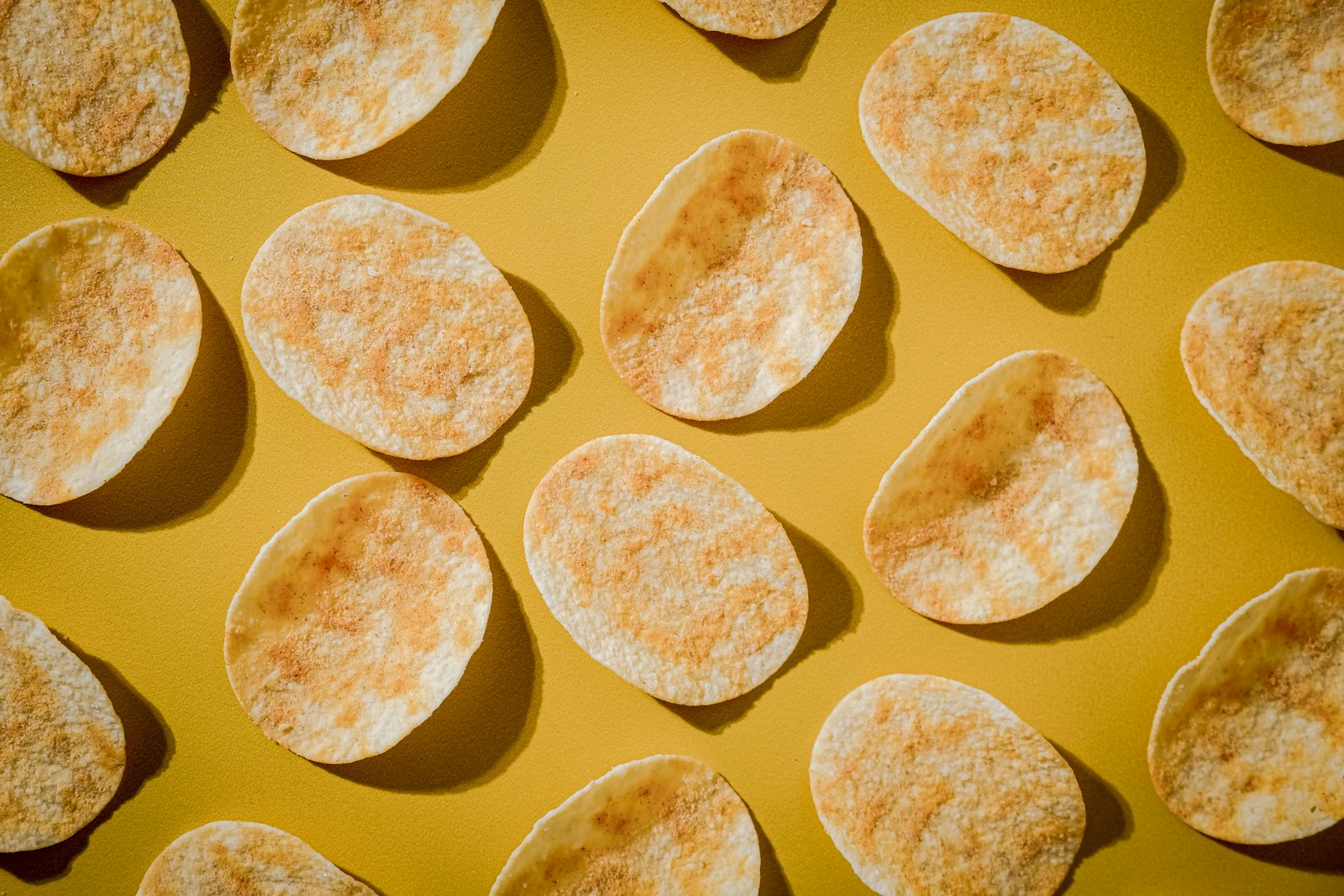
Illustrative image only; unrelated to real brands or clients. It does not depict a TUSKO client, product or factory. TUSKO maintains client and commercial confidentiality under NDA.
Unsplash illustration of round snack crackers; the image does not show a TUSKO client product, brand or ASEAN factory.
Extruded snacks and rice crackers are among Southeast Asia's fastest-growing export snack categories, sold as own-label crisps, puffs, sticks and crackers through supermarkets, discounters and online channels. For a retailer or brand owner in North America, Europe, the UK or Australia, the flavour is only the start: oil quality, acrylamide control, seasoning consistency, allergen declarations and packaging fragility determine whether the product can legally and profitably reach shelves. This ASEAN manufacturing and export guide is written for importers, OEMs and distributors in the United States, European Union, United Kingdom, Australia, Canada and Japan who need a dependable route from specification to delivered, compliant goods.
Quick Answer: What Should an Overseas Buyer Specify?
Start with the complete application and a controlled specification, then qualify the actual manufacturing route. For extruded snacks and rice crackers, the critical details are base material (rice, corn, tapioca or blends), process route (direct-expanded, pellet or baked cracker), frying versus baking, seasoning formula, nutrition targets, pack format and shelf life. Require documented first-article and shipment acceptance, verify destination-market obligations for the exact product, and review landed cost with current origin and customs evidence. A country name, certificate logo or matching photograph is not enough to approve a substitution.
Where in ASEAN Should You Evaluate Manufacturing?
ASEAN is a region, not a guarantee of a particular production capability. Compare manufacturing sites in Thailand, Vietnam, Malaysia and Indonesia using the same evidence pack. Country choice should follow verified process capability, component availability, export execution and the buyer’s required volume. This table is a screening framework, not a claim that every country has qualified suppliers for this product.
| Location to evaluate | Evidence to request | Decision rule |
|---|---|---|
| Thailand | Food/HACCP or GMP certification scope, lab testing and shipment route | Advance only a site whose documented process fits the approved design |
| Vietnam | Production versus trading role, component traceability and change control | Verify local manufacturing steps and qualification evidence |
| Malaysia | Application knowledge, material records and relevant test capability | Check model-specific scope rather than relying on a certificate logo |
| Indonesia | Halal, process controls, packing and export documentation | Confirm repeat-lot consistency and a viable shipment plan |
For extruded snacks, imported seasonings, oils or packaging films may be part of an ASEAN build. Identify material and component sources, transformation steps and the applicable origin rule before making a country-of-origin claim. Shipment from an ASEAN port does not by itself establish ASEAN origin, and an attractive unit quotation should not outweigh missing qualification evidence. Compare the same approved specification across candidates and document unresolved questions before choosing a production route.
How Extruded Snacks & Rice Crackers Are Manufactured and Qualified
Production typically runs raw-material milling and blending (rice, corn grits or tapioca starch), extrusion cooking or sheet forming, cutting, then frying in palm oil or hot-air baking, seasoning application in a tumbling drum, and nitrogen-flushed packing. Seasoning powders are often made in-house or bought from specialist flavour houses. Oil management (free fatty acids, peroxide value, frying temperature), expansion ratio, moisture after drying and seasoning adhesion are the main process risks. Confirm whether the site runs its own seasoning line and how it segregates allergens such as wheat, soy, milk, crustacea and sesame.
Ask TUSKO to establish which operations are performed at the manufacturing site and which components are externally procured, then build the inspection plan around the actual process. Before changing production location, compare the approved specification, ingredient list and lab results with your current product rather than copying a retail sample.
Key Specifications to Lock Before Requesting Quotes
Use the following as a product-specific RFQ checklist. State the specification version, recipe or formula reference, distinguish mandatory requirements from optional preferences, and require written clarification where the proposed build differs. A quoted alternative should identify the deviation so it can be reviewed before approval.
| Specification | What to define | Why it matters |
|---|---|---|
| Base material | Rice, corn, tapioca or blend; whole-grain claims | Changes texture, cost and claims |
| Process route | Direct-expanded, pellet/half-product or baked cracker | Determines line capability and oil content |
| Cooking method | Fried in specified oil or hot-air baked | Changes fat content and retailer policies |
| Seasoning | Flavour profile, MSG, allergen carriers, colour | Flavour houses may restrict formula disclosure |
| Pack format | Pillow bag, stand-up pouch; material structure | Moisture/oxygen barrier and fragility control shelf life |
| Shelf life | Target months and storage conditions | Drives oxidation testing and stock rotation |
Product Details That Change the Order
The cooking route changes both nutrition and regulation. Baked snacks reduce fat declarations but change texture and may raise acrylamide risk depending on recipe and browning; fried snacks need documented oil management. Define sensory benchmarks against your current product and run blind tastings with target consumers before locking the formula.
Seasoning formulas are often the flavour house's intellectual property. Agree how formula changes are notified, and require the allergen and additive declaration even when the full formula stays confidential.
Palm oil sourcing is a reputational and regulatory topic: buyers may ask for RSPO-certified supply chains and deforestation-related due diligence, especially for the EU market.
Quality Checks and First-Article Acceptance
Agree on the evidence before production starts. Tests need a method, conditions and acceptance limits, not simply a request for a test certificate. Distinguish first-article checks, which prove the formula and process can deliver the specification, from routine lot checks, which confirm each shipment stays within it. Record sample sizes and the response if a lot fails.
| Check | Method or evidence | Acceptance focus |
|---|---|---|
| Microbiology | Lab tests on finished goods per agreed plan | Within specified limits for pathogens and indicators |
| Oil quality | Peroxide value and free fatty acid in product and frying oil | Within agreed limits; trend monitoring |
| Moisture and water activity | Lab measurement after drying or frying | Supports shelf-life target and crispness |
| Acrylamide | Third-party lab test per recipe where baked or browned | Meets EU benchmark levels where applicable |
| Seasoning coverage | Visual and weight checks per sampling plan | Uniform flavour; within agreed tolerances |
| Packaging | Seal strength, nitrogen flush level, print and barcode check | Intact seals; correct label and GTIN |
Destination-Market Compliance for Extruded Snacks & Rice Crackers
In the United States, the manufacturing facility must be registered with FDA, the importer must comply with the Foreign Supplier Verification Program, and labels need Nutrition Facts and allergen declarations under FALCPA and the FASTER Act (sesame). Prior notice is required for each shipment.
In the EU, Regulation (EU) 1169/2011 governs food information and Regulation (EU) 2017/2158 sets acrylamide mitigation and benchmark levels for crisps and crackers; only authorised additives and flavourings may be used. The UK applies equivalent retained rules and its own import controls.
Australia and New Zealand apply the Food Standards Code, and imported food may be inspected and tested under the Imported Food Inspection Scheme. Health Star Rating is voluntary but often expected by retailers.
Regulations change and depend on the exact configuration, so confirm current requirements with a qualified customs broker, food or product regulatory specialist before the first shipment. TUSKO coordinates the evidence pack but does not replace legal or conformity-assessment advice.
Landed Cost: What to Include Before Comparing Quotes
Compare delivered cost, not unit price. The following structure keeps quotations comparable. Figures depend on volume, specification and route, so no universal price or saving is implied.
| Cost element | What to confirm | Why it matters |
|---|---|---|
| Ex-works or FOB unit price | Quoted against the same approved specification and revision | Different specs make price comparison meaningless |
| Tooling, samples and first-article work | One-off or amortised; who owns tooling | Affects true cost of the first orders |
| Packing and palletising | Export packing, labelling, moisture and impact protection | Damage claims erase unit-price savings |
| Freight and insurance | Mode, consolidation and Incoterm responsibility | Volume and density drive cost per unit |
| Duties and border costs | Tariff classification, origin evidence, trade-remedy checks | Classification and origin must be verified for the exact product |
| Testing and compliance | Third-party tests, certificates and marking work | Required before sale in many destination markets |
Sampling and Production Process
A disciplined sequence reduces surprises: (1) send the specification pack and target market, label and packaging details; (2) receive clarifications and deviations in writing; (3) approve pre-production samples against measured data; (4) run a pilot lot with first-article inspection; (5) release mass production with in-process and pre-shipment checks; (6) review the first delivered lot and lock the change-control process. Any change of ingredient, packaging material, sub-supplier or process after approval should require written notice and re-qualification proportional to the risk.
Five Common Mistakes When Sourcing Extruded Snacks & Rice Crackers
- Approving by taste only. Risk: Label, allergen or additive failures at the border. Fix: Review the recipe against each market's rules early.
- Ignoring oil quality monitoring. Risk: Rancid flavour before end of shelf life. Fix: Set PV/FFA limits and accelerated tests.
- Underestimating pack fragility. Risk: Crushed product and high damage claims. Fix: Specify film, nitrogen flush and carton strength; run transit tests.
- Unverified halal or vegan claims. Risk: Claim removal or recall in sensitive markets. Fix: Verify certification scope for the exact line and recipe.
- No acrylamide plan for baked lines. Risk: EU benchmark exceedance. Fix: Set baking controls and test per recipe.
Frequently Asked Questions
Can I private label extruded snacks or rice crackers from ASEAN?
Yes; Thailand, Vietnam and Indonesia have large snack industries, but each site's certifications, export history to your market and recipe flexibility must be verified.
What is the MOQ for private label snacks?
It depends on pack format and print method; printed film usually sets the minimum, while sticker labels can lower entry quantities.
Can factories make baked instead of fried snacks?
Many export lines offer both; baked products change texture and fat declarations, so re-validate taste and shelf life.
How long is the shelf life?
Commonly six to twelve months depending on oil system, packaging barrier and storage; it must be validated for your recipe.
Which certifications should a factory have?
Typically HACCP, GMP and a GFSI-recognised scheme such as BRCGS, FSSC 22000 or IFS, plus halal where required.
What should I send TUSKO for a snack enquiry?
Target product or benchmark, base material, fried or baked, flavours, pack format, nutrition targets, allergens, certifications, destination markets and expected volumes.
How TUSKO Supports Your ASEAN Sourcing Enquiry
TUSKO supports ASEAN sourcing and trade enquiries as your single point of contact. Send the specification pack, destination, required documentation and expected order pattern so the enquiry can be evaluated against real capability and shipment requirements. The order quotation is assessed against the agreed scope and landed-cost assumptions, rather than an unsupported promise of the lowest price.
Email hello@tuskoconsulting.com or reach WhatsApp Business @tuskoconsulting through the contact page. We reply within 12–24 hours. For preliminary budgeting, use the landed-cost calculator; explore the ASEAN product recommender for related categories.
Sources and Scope
The technical guidance draws on publicly available manufacturer documentation and official standards or regulatory guidance. These sources explain product selection and scope; they do not verify a particular ASEAN manufacturing site, imply a TUSKO client result or establish universal prices, capacity or lead times.
- US FDA – Food Facility Registration and FSVP
- European Commission – Food Safety
- UK Food Standards Agency – Importing food
- Australian Department of Agriculture – Importing food